Most beginner aquarists start with plastic plants. They look decent, they do not die, and there is nothing to figure out. But the moment you replace even one plastic piece with a live moss plant, the tank transforms completely. The water feels alive. The fish behave differently. The whole setup looks like something from nature rather than a pet store shelf.
Fish tank moss plants are the single best entry point into live planted aquariums. They are forgiving, adaptable, and genuinely useful for fish and shrimp. They work in small tanks and large ones, with CO2 injection and without it, in high light setups and low light ones.
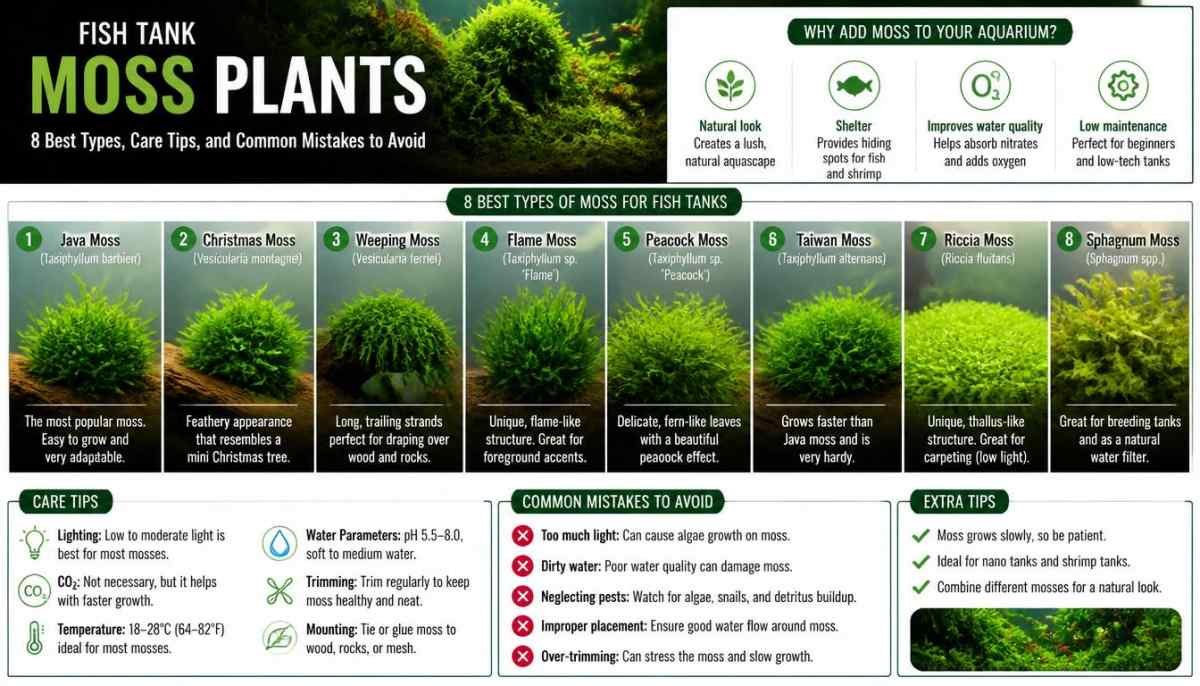
This guide covers the eight best moss plants for fish tanks, how to attach and care for them properly, which fish work well with them, and the mistakes that kill moss before it ever gets started.
Why Add Moss Plants to Your Fish Tank
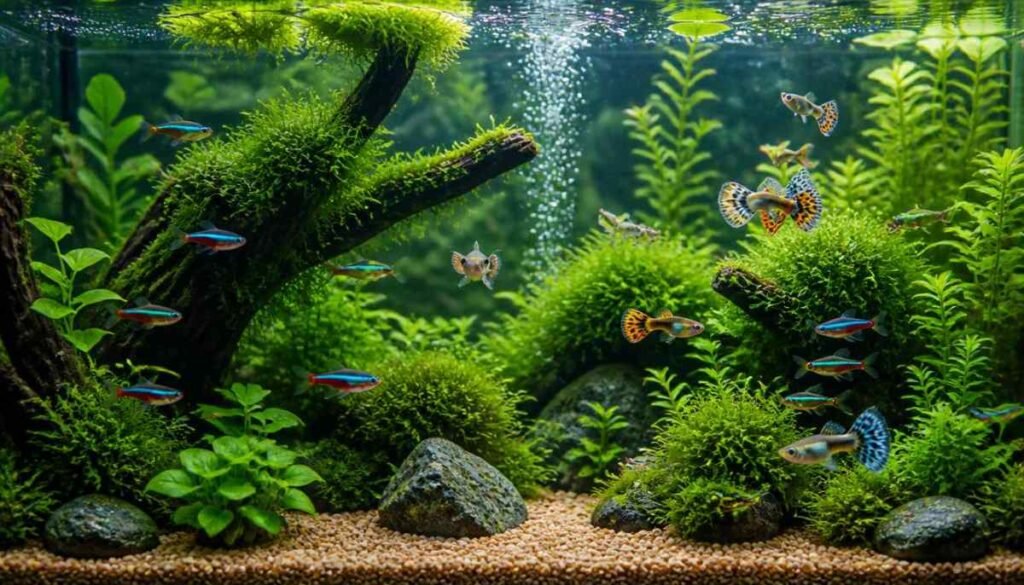
Before getting into the individual types, it is worth understanding what moss actually does for a tank beyond looking good.
Natural Water Filtration
Moss absorbs dissolved nitrates and phosphates directly from the water column. These compounds build up from fish waste and leftover food and can cause algae problems and stress fish over time. A healthy moss growth does not replace regular water changes, but it does help maintain better water quality between them.
Shelter and Safety for Fish and Shrimp
Dense moss growth gives small fish, baby fry, and shrimp a place to hide and feel secure. In breeding setups, moss is often essential. Fish eggs deposited in moss have a much better survival rate than eggs left in the open. Baby shrimp, which are extremely vulnerable in their first weeks, use moss constantly for cover and feeding.
Biofilm and Grazing Surface
Biofilm is a thin layer of microorganisms that forms on surfaces in established tanks. Shrimp in particular depend on biofilm as a primary food source. Moss, with its dense structure and high surface area, accumulates biofilm faster than almost any other surface in the tank. Shrimp will graze on moss continuously throughout the day.
Aquascape Depth and Natural Texture
Smooth glass, plastic decorations, and bare substrate look flat. Moss adds a texture and color depth that no other plant replicates. Whether you are growing it as a carpet, covering driftwood, or creating a moss wall, the effect is one of genuine naturalism that raises the visual quality of any tank significantly.
8 Best Fish Tank Moss Plants
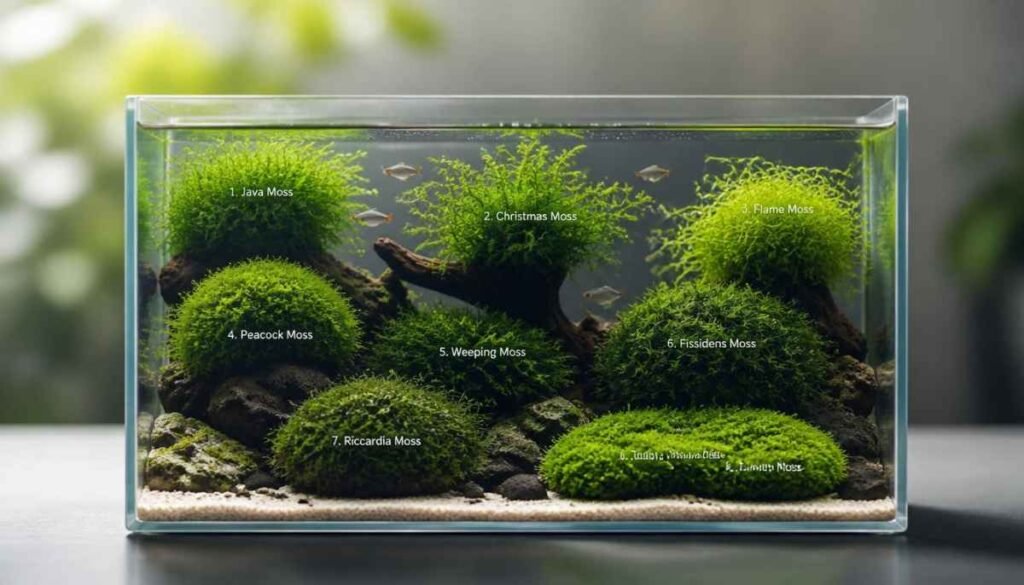
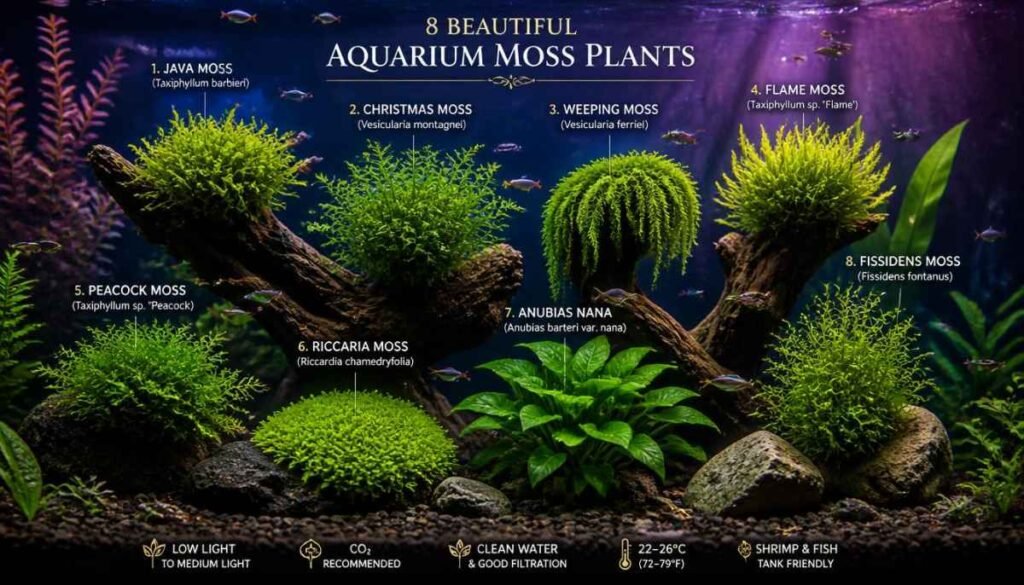
1. Java Moss
Java moss is the starting point for almost every aquarist who tries live plants. It is nearly impossible to kill, grows in a wide range of water conditions, requires no special lighting or fertilization, and looks good in almost any tank.
The growth pattern is loose and branching, forming irregular green mats that spread gradually over whatever surface they are attached to. Under low light it stays a deeper green. Under stronger light it brightens and grows more densely.
Java moss attaches well to driftwood, rocks, and mesh. It is the best moss for breeding tanks because its dense, tangled structure gives fish eggs and fry exceptional cover. It is also the first choice for shrimp tanks.
Care level: Beginner. Temperature range: 15 to 30 degrees Celsius. Light requirement: Low to moderate.
2. Christmas Moss
Christmas moss gets its name from its growth structure. When attached to driftwood or a flat surface, the side branches grow outward and slightly downward in a pattern that resembles fir tree branches, giving it a layered, structured look that Java moss does not have.
It grows more slowly than Java moss and requires slightly more stable water conditions to look its best. The result, when it is thriving, is one of the most visually impressive mosses available for home aquariums. It works exceptionally well attached to driftwood as a focal point.
Care level: Beginner to intermediate. Temperature range: 18 to 26 degrees Celsius. Light requirement: Low to moderate.
3. Flame Moss
Flame moss grows differently from almost every other aquatic moss. Instead of spreading outward or hanging downward, it grows upward in a spiral twist, with each strand curling as it extends toward the surface. The overall effect, when a clump is established and healthy, genuinely resembles a small flame rising from the substrate or hardscape.
It grows slowly and is best suited to tanks where it can be a visual centerpiece rather than background coverage. Attach it to a small rock or piece of wood and place it in a prominent position where the upward growth can be fully appreciated.
Care level: Intermediate. Temperature range: 20 to 28 degrees Celsius. Light requirement: Low to moderate.
4. Weeping Moss
Weeping moss grows in the opposite direction from flame moss. Its branches extend outward and then curve downward under their own weight, creating a flowing, cascading effect. When attached to elevated hardscape such as driftwood positioned above the substrate, the hanging growth creates a natural waterfall or curtain effect.
It is a slower grower than Java moss but rewards patience with a distinctive look that is difficult to replicate with any other plant. It performs well in shrimp tanks and breeding setups.
Care level: Intermediate. Temperature range: 18 to 26 degrees Celsius. Light requirement: Low to moderate.
5. Peacock Moss
Peacock moss has a finer, softer texture than most other aquarium mosses. The fronds are narrow and closely spaced, giving it a velvet-like appearance when viewed from a distance. It grows in overlapping layers that fan outward from attachment points.
It is particularly popular in shrimp tanks because its dense, fine structure creates an enormous amount of surface area for biofilm accumulation. Shrimp will pick at peacock moss continuously. It also works well as foreground coverage on substrate or flat stones.
Care level: Beginner to intermediate. Temperature range: 18 to 26 degrees Celsius. Light requirement: Low to moderate.
6. Fissidens Nobilis
Fissidens nobilis is the most demanding moss on this list and also the most visually striking. Its fronds are broad and flat, with a structured, feather-like appearance that looks unlike any other aquatic moss. When a healthy mat of fissidens is established in a well-maintained tank, the effect is extraordinary.
It requires cleaner water, more stable parameters, and better lighting than beginner mosses. It also grows very slowly. However, for aquarists who have mastered the basics and want to elevate their aquascape, fissidens is worth the additional effort.
Care level: Advanced. Temperature range: 20 to 26 degrees Celsius. Light requirement: Moderate.
7. Marimo Moss Ball
Marimo moss balls are technically not moss. They are a spherical form of filamentous green algae called Aegagropila linnaei, which grows naturally in lakes in Japan, Iceland, and parts of Eastern Europe. In aquarium culture they are universally classified alongside moss plants because they serve similar functions and require similar care.
They grow very slowly into dense, velvety green spheres and require essentially no maintenance. Rotate them occasionally so all sides receive light. They absorb nitrates from the water, provide grazing surfaces for shrimp, and add a unique visual element that works in almost any tank style.
Care level: Beginner. Temperature range: 15 to 25 degrees Celsius. Light requirement: Low.
8. Subwassertang
Subwassertang is another plant that is classified as moss in the aquarium hobby but is technically a liverwort. Its appearance is completely different from any other moss on this list. It grows in flat, rounded lobes with a smooth surface, forming loose, floating masses or attaching loosely to hardscape.
Its unusual appearance divides opinion, but shrimp absolutely love it. The structure creates an enormous amount of surface area for biofilm and provides excellent shelter for baby shrimp. In shrimp-focused tanks, sub-wasting is a genuine standout.
Care level: Beginner. Temperature range: 15 to 28 degrees Celsius. Light requirement: Low.
Quick Comparison: All 8 Moss Types at a Glance
| Moss Type | Difficulty | Light | Best For | Growth Speed |
| Java Moss | Beginner | Low | Breeding, shrimp, beginners | Medium |
| Christmas Moss | Beginner | Low to moderate | Driftwood, display tanks | Slow |
| Flame Moss | Intermediate | Low to moderate | Focal point, aquascape | Slow |
| Weeping Moss | Intermediate | Low to moderate | Elevated hardscape, shrimp | Slow |
| Peacock Moss | Beginner | Low to moderate | Shrimp tanks, foreground | Slow to medium |
| Fissidens Nobilis | Advanced | Moderate | Advanced aquascapes | Very slow |
| Marimo Moss Ball | Beginner | Low | Any tank, low maintenance | Very slow |
| Subwassertang | Beginner | Low | Shrimp tanks, breeding | Medium |
How to Attach Moss in Your Fish Tank
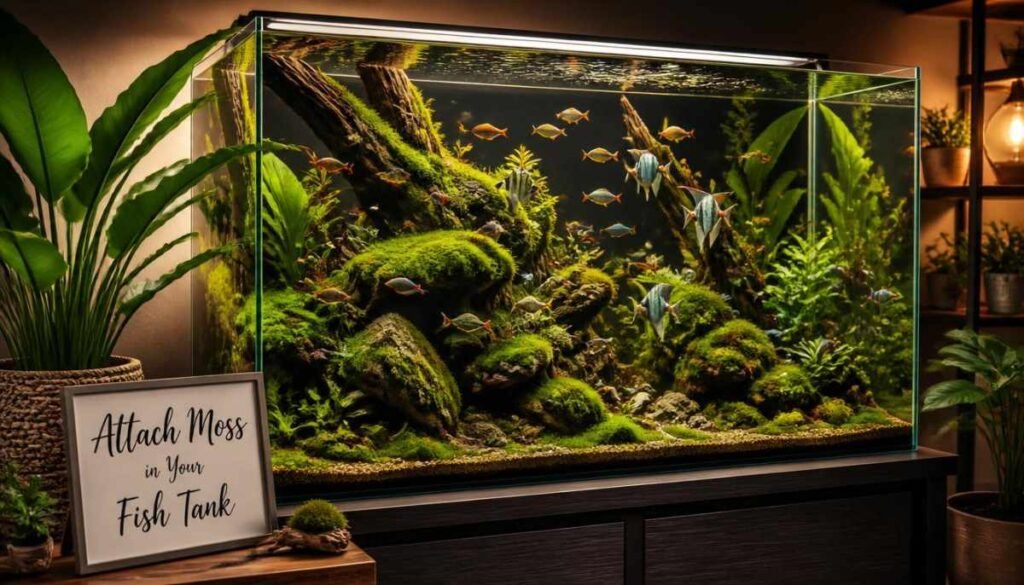
Most aquarium moss does not naturally anchor itself to surfaces quickly. Left floating or simply placed on substrate, it will drift around the tank and never establish properly. Attaching it correctly is the single most important practical step in getting moss to grow well.
Method 1: Fishing Line or Cotton Thread
Cut a length of clear fishing line or dark cotton thread. Take a small portion of moss and press it flat against the surface you want to cover, whether that is a piece of driftwood, a smooth rock, or a mesh grid. Wrap the fishing line around the moss and the surface several times, keeping the moss pressed firmly against the hardscape. Tie it off securely.
Over several weeks the moss will send out small attachment structures called rhizoids that grip the surface on their own. Once it has anchored naturally, you can cut away the fishing line if desired, though it is not necessary.
Cotton thread will break down in water over time. This works well because by the time the thread disintegrates, the moss has usually anchored itself. Fishing line does not break down but is nearly invisible in the tank.
Method 2: Aquarium-Safe Superglue
Gel-type superglue with ethyl cyanoacrylate as the active ingredient is completely safe for aquarium use once it has cured. Apply a small amount of gel directly to the surface you want to cover. Take a fingertip-sized portion of moss, press it firmly into the glue, and hold it in place for fifteen to twenty seconds.
The glue will leave a white residue on the hardscape initially, but moss growth will cover it within a few weeks. This method is faster than fishing line and gives more precise placement for detailed aquascaping work.
Method 3: Moss Mats and Mesh
For creating moss carpets on the substrate, sandwich a thin layer of moss between two pieces of plastic mesh cut to the size you want. The mesh keeps the moss flat and in position while it anchors. Once the moss has grown through and attached to the mesh, you can remove the top layer of mesh or leave it in place as it becomes invisible under the growth.
Moss Care Tips for a Healthy Fish Tank
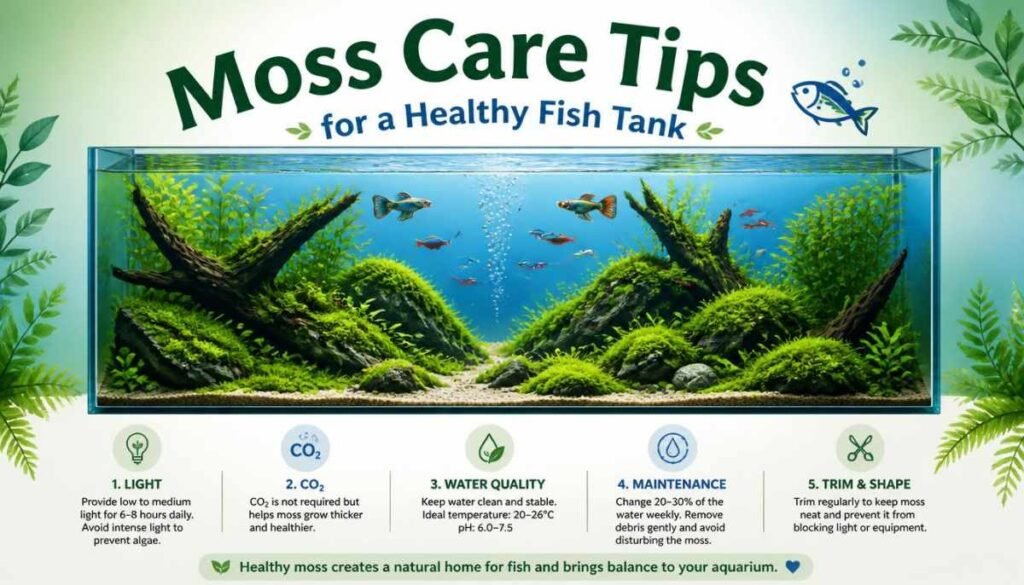
Light Requirements
Most aquarium mosses grow well in low to moderate light. High-intensity lighting does not improve moss growth and often causes algae to take hold in the moss itself, which is one of the most frustrating problems in moss care. If your tank has strong lighting, consider placing moss in shadier positions or reducing your lighting duration to eight to ten hours per day.
Temperature
Mosses generally prefer cooler water. Most species perform best below 26 degrees Celsius. At higher temperatures the growth becomes less compact and the color can shift toward yellow-green. In warm tropical tanks this is manageable, but if you are keeping mosses as the primary plant focus, keeping temperatures on the lower end of your fish’s tolerance range will produce better results.
Water Changes and Filtration
Clean, well-filtered water is the most important factor in long-term moss health. Mosses are not demanding in terms of nutrients, but they are sensitive to poor water quality and unstable parameters. Weekly water changes of around 30 to 50 percent, combined with adequate filtration, give moss the stable environment it needs to stay healthy.
Maintain good water flow in the tank. Moss traps debris easily, and without sufficient current, detritus will accumulate in the moss and create the conditions algae need to establish. A filter turnover rate of six to ten times the tank volume per hour is a reasonable target.
Trimming
Moss benefits from regular trimming. As it grows, the outer portions receive light while the inner sections become shaded. Over time this creates a layered structure where only the surface is actively growing and the interior is dead material. Trimming the outer growth every few weeks encourages new growth from the base and keeps the moss looking full and healthy rather than stringy and sparse.
CO2 and Fertilization
CO2 injection is not necessary for most aquarium mosses, but it does accelerate growth and improve color and density. Liquid fertilizers used sparingly can also support moss growth. The risk of over-fertilization is algae, so err on the side of less rather than more. Most mosses in a tank with fish and regular feeding will have enough nutrients from the water column without additional fertilization.
Not all fish are moss-friendly. Understanding which species work well with moss saves you from planting a beautiful setup only to watch it get dismantled.
Excellent Companions
Tetras, rasboras, guppies, endlers, small danios, and most small peaceful community fish coexist well with moss. These fish may pick at the moss occasionally but do not damage it. Cherry shrimp, Amano shrimp, crystal shrimp, and most other dwarf shrimp species are ideal moss companions. They feed on biofilm that accumulates in the moss, clean debris, and rarely cause any damage.
Corydoras and other bottom-dwelling fish that forage on the substrate can disturb moss carpets but generally do not damage attached moss on hardscape.
Species to Approach Carefully
Goldfish will eat or uproot most aquatic plants including moss. They are not suitable tank companions for moss plants. Large cichlids are known to dig and rearrange tank contents and can uproot or shred moss that is not firmly attached. Certain barb species, particularly larger ones, may nip at moss and pull pieces free during normal feeding behavior.
If you want to keep moss with these species, focus on firmly attached moss on heavy hardscape and accept that the setup may require more frequent maintenance.
Common Mistakes That Kill Aquarium Moss
Placing Moss in Too Much Light
High light causes algae to grow in the moss before the moss itself can outcompete it. Once algae is established in moss it is nearly impossible to remove without damaging the plant. Always start moss in lower light conditions and observe the results before increasing intensity.
Using the Wrong Glue
Not all superglue is aquarium-safe. Only use gel-type superglue where the active ingredient listed is ethyl cyanoacrylate. Other formulations may contain additives that are toxic to fish and invertebrates.
Letting Moss Float Freely
Moss that is not attached will drift around the tank, get caught in filter intakes, and never establish properly. Always attach or anchor moss before placing it in the tank.
Overfeeding the Tank
Excess food means excess nutrients, which feeds algae. Algae in moss is the most common cause of moss decline in home aquariums. Feed fish only what they can consume in two to three minutes and remove any uneaten food promptly.
Keeping Water Too Warm
Many aquarists keep moss in tropical tanks set at 28 degrees Celsius or higher. Most moss species will survive at this temperature but will not thrive. If the temperature is within your control, keeping it at 24 to 26 degrees Celsius gives moss significantly better growing conditions.
Neglecting Water Changes
Moss is sensitive to nitrate accumulation over time. Irregular water changes are one of the quieter causes of moss decline because the effects are gradual. Consistent weekly partial water changes make a measurable difference in long-term moss health.
FAQ: Fish Tank Moss Plants
What is the easiest moss to grow in a fish tank?
Java moss is the easiest and most forgiving aquarium moss available. It grows in low light, tolerates a wide range of water parameters, requires no CO2 or fertilization, and attaches to almost any surface. It is the right starting point for any aquarist adding live moss for the first time.
Does aquarium moss need CO2?
No. Most aquarium mosses grow without CO2 injection. CO2 does improve growth speed and density, but it is not required. In a tank with fish, mosses typically have enough carbon dioxide from fish respiration to grow adequately.
How do I stop algae growing in my aquarium moss?
Reduce lighting intensity or duration, perform regular water changes, avoid overfeeding, and maintain good water flow. If algae is already established in moss, remove the affected sections by trimming and adjust the tank conditions before the remaining moss becomes affected.

Jack Rivers is the founder of Plantsopedia, dedicated to making plant care simple, science-backed, and accessible for everyone. With a deep interest in botanical care and plant psychology, he specializes in rare tropical species and organic growth techniques, helping enthusiasts understand the soil, light, and biology behind every thriving plant. When he’s not experimenting with new propagation methods, Jack is busy turning complex horticultural science into practical, everyday advice for home gardeners