The best plants for betta fish are Java Fern, Anubias, Cryptocoryne, Amazon Frogbit, and Water Sprite all thrive in low to moderate light with no CO₂ required. For a 5-gallon tank, 3–5 plants covering roughly 50–70% of the tank creates the ideal balance of cover and swimming space. Full plant-by-plant breakdown, care tips, and what to avoid is below.
I set up my first betta tank with plastic plants from a pet shop. The fish barely explored, stayed near the surface, and looked permanently stressed. When I switched to live plants just a single Anubias nana on a piece of driftwood the change was immediate. Within a week he was weaving between leaves, resting on broad surfaces, behaving like a fish that actually had a home.
This guide covers every plant that genuinely works for betta fish not a recycled list. You will find out why each one benefits bettas specifically, what to avoid, and how to set up a planted tank without wasting money or killing plants.
Why Betta Fish Need Live Plants (Not Just Look Nice With Them)
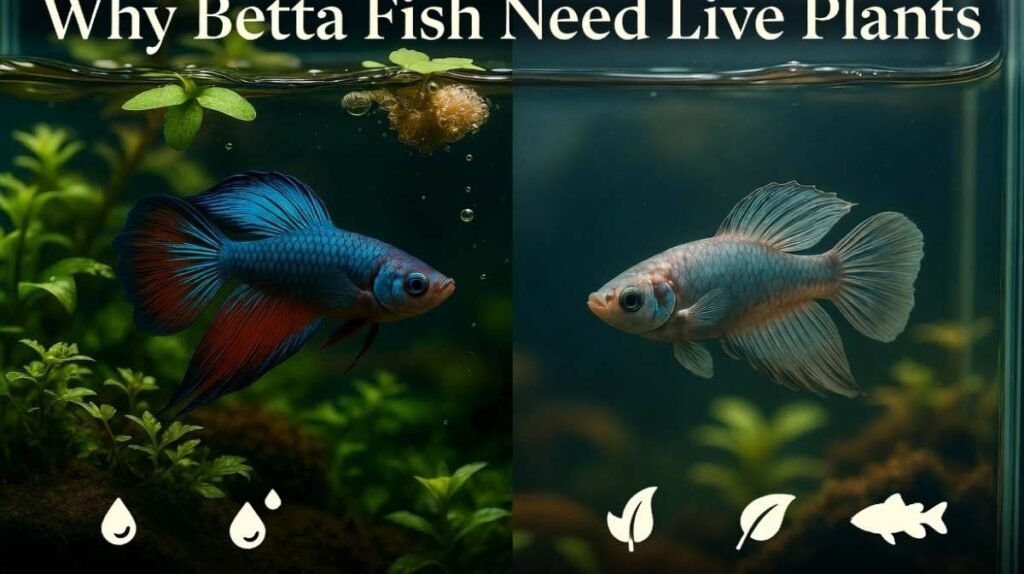
Most people treat aquarium plants as decoration.For bettas, live plants are closer to a home than a decoration.
Betta splendens evolved in the rice paddies and slow-moving streams of Southeast Asia dense with vegetation. In the wild, they hide in root systems, rest under floating leaves, and use plant cover to break line of sight from rivals. A planted tank replicates that, and it makes a real difference.
Live plants absorb ammonia, nitrites, and nitrates the waste products that stress fish in a closed tank. A few plants working together noticeably slow how fast water quality deteriorates between changes. They also give bettas something to do. A bare tank offers nothing to explore. A planted one gives them leaves to investigate, roots to swim through, and broad surfaces to rest on. Boredom in bettas is a genuine problem that rarely gets discussed plants solve most of it.
Stress matters too. A betta in a planted tank feels less exposed. Chronically stressed bettas show faded color, clamped fins, and weakened immunity. A well-planted tank is not a luxury it directly affects health.
What Makes a Plant Genuinely Good for Bettas
Not all aquarium plants are suitable for betta tanks. Bettas have specific requirements that narrow the field considerably.
Low to moderate light tolerance. Most betta setups use a basic LED strip light, not a high-powered planted tank fixture. Plants that need intense light will slowly die in a standard betta setup. Java Fern, Anubias, Cryptocoryne, and most floating plants are designed for exactly this situation.
Low or no flow compatibility. Bettas hate strong water movement. Their long fins are not built for current. That also means plants that require high turnover to stay healthy are a poor match. Slow-growing rhizome plants and surface floaters are ideal they thrive in the calm conditions bettas need.
No sharp edges. A betta’s fins are delicate. Any plant with stiff, sharp, or coarse leaves can tear fins over time. Plastic plants are often worse offenders than live ones, but some live plants (like certain hornwort varieties) can be abrasive. Stick to soft-leafed or broad-leafed species.
Size appropriate for nano tanks. Most bettas live in 5–10 gallon tanks. Tall background plants like full-size Amazon Swords can work in a 10-gallon but overwhelm a 5-gallon. Compact plants and varieties that stay manageable are more practical for most betta setups.
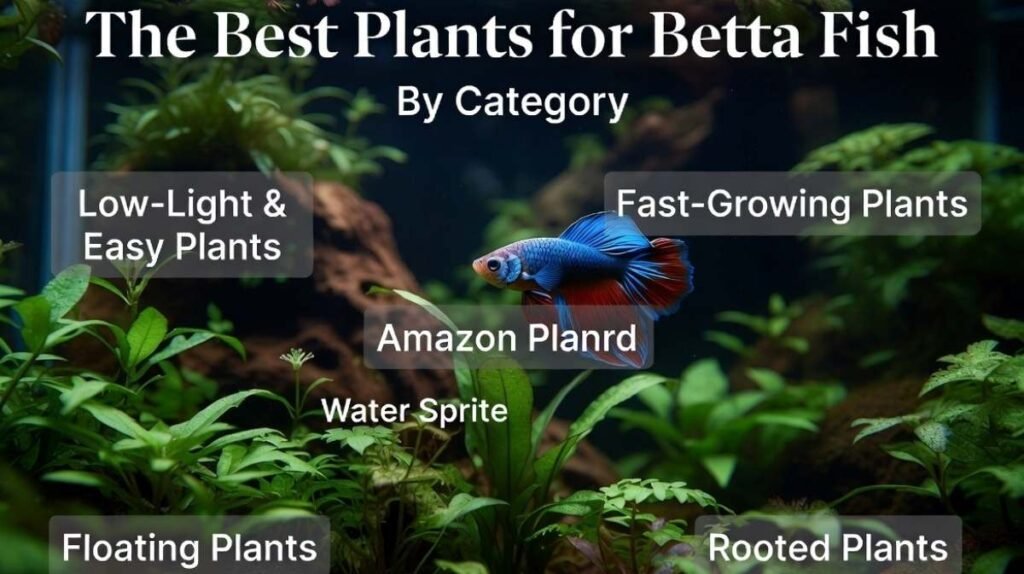
The Best Plants for Betta Fish (By Category)
Rhizome Plants The Foundation of Any Betta Tank
Java Fern (Microsorum pteropus)
Java Fern is the single most beginner-proof plant in the freshwater hobby, and it happens to be perfect for bettas. The thick, textured fronds grow from a horizontal rhizome a stem-like structure that should never be buried in substrate. Attach it to driftwood or a rock using super glue gel or cotton thread and leave it alone. It will grow slowly, and that is fine.
What makes Java Fern exceptional for bettas is its leaf structure. The fronds are long, broad, and wavy substantial enough for a betta to investigate underneath, and interesting enough that they actually do. In low-light setups, this plant just works without any fuss.
One thing most guides skip: those black or brown spots on the leaves are not disease. They are spore cases for new plantlets. Wait, and you will eventually see small new Java Ferns growing directly off the parent leaves. It is genuinely one of the more interesting reproductive strategies in aquatic plants.
Care snapshot:
| Parameter | Requirement |
| Light | Low to moderate |
| CO₂ | Not required |
| Substrate | Not needed attach to hardscape |
| Fertilizer | Optional liquid, monthly |
| Growth rate | Slow |
| Best tank size | 5 gallons and up |
Anubias
If Java Fern is the most beginner-proof plant, Anubias is the most betta-specific. The broad, dark green leaves are exactly the right size and shape for a betta to use as a resting surface a natural version of the commercial “betta hammock” sold in pet shops, except that it is alive, filters the water, and looks far better.
Anubias barteri varieties are the most common and most practical. Anubias nana stays compact (ideal for 5-gallon tanks), while Anubias barteri proper grows slightly larger and suits 10-gallon setups. and anubias nana petite is the smallest option delicate and beautiful, but slower-growing than standard nana.
Like Java Fern, never bury the rhizome. Attach it to hardscape. Unlike Java Fern, Anubias is prone to algae on its leaves because it grows so slowly that algae can colonize the leaf surface before the plant sheds them. Keep it out of direct, intense light and this problem rarely develops.
Bettas that live with Anubias use it constantly. They rest on the leaves during the day, investigate the underside for food particles, and generally treat the plant as the center of their territory. It is arguably the single most important plant you can add to a betta tank.
Bucephalandra
Bucephalandra is less commonly discussed in beginner guides but deserves attention. It grows similarly to Anubias attached to hardscape, low light, slow growth but its leaves have an iridescent shimmer that makes it visually striking. It stays compact naturally, suits nano tanks perfectly, and requires essentially the same care as Anubias. If you want something slightly more unusual than standard Anubias, Bucephalandra is the next step.
Rooted Plants Mid and Background Options
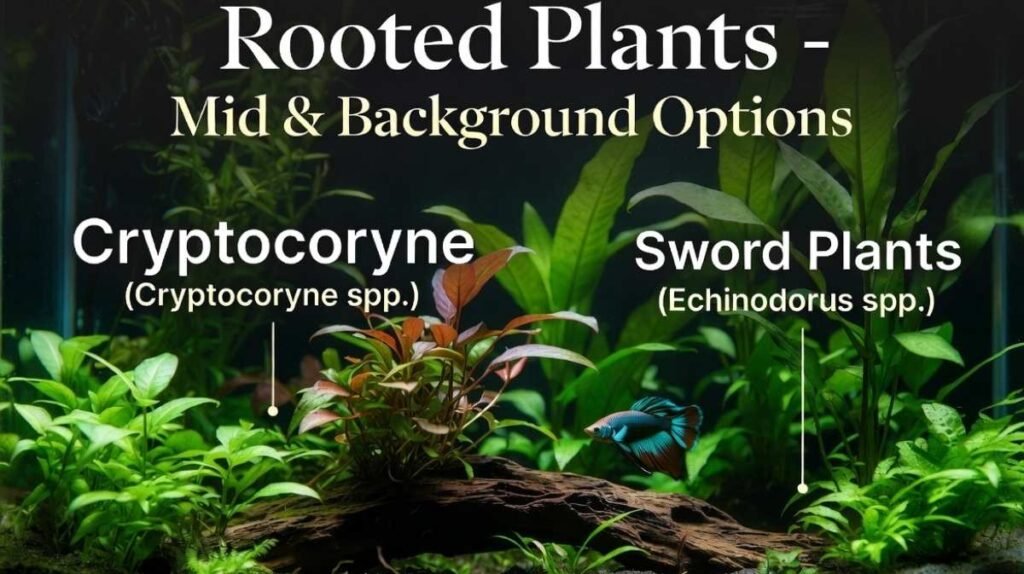
Cryptocoryne (Cryptocoryne spp.)
Cryptocoryne called “crypts” in the hobby are among the most practical plants for a betta tank. They come in a wide range of sizes and colors, from the compact dark-green Cryptocoryne parva to the broad, copper-toned Cryptocoryne wendtii.
Unlike Java Fern and Anubias, crypts feed through their roots. Plant them in substrate and add a root tab near the base every three to four months in inert gravel or sand, that fertilizer is not optional.
One thing every new crypt owner needs to know: crypt melt is real. After planting, the leaves often turn mushy and transparent within the first week or two. It looks like the plant is dying it is not. The nursery grew it above water, and it is now shedding those leaves to regrow ones adapted to your tank. Leave the roots alone. New growth appears within two to four weeks, and what comes back is stronger than what you bought.
Once established, crypts are nearly indestructible. Cryptocoryne wendtii produces the broad, wavy leaves bettas love to rest on. Cryptocoryne spiralis grows tall and fills a background without overwhelming a smaller tank.
Sword Plants (Echinodorus spp.)
Amazon Swords and their smaller relatives work in betta tanks with some caveats. Full-size Amazon Swords (Echinodorus bleheri) grow large too large for anything under 10 gallons. The leaves can reach 18 inches in a healthy, established plant, and they require moderate light and nutrient-rich substrate to perform well.
In a 10-gallon betta tank, a single Amazon Sword as a centerpiece or background plant creates a stunning visual effect and gives the fish broad leaves to rest beneath. In a 5-gallon, skip it.
Dwarf variants like Echinodorus tenellus (pygmy chain sword) stay low and compact, spreading across the foreground via runners. This works beautifully in larger betta tanks where you want a carpeted foreground effect without the carpeting plant maintenance nightmare.
Floating Plants Underrated and Highly Effective
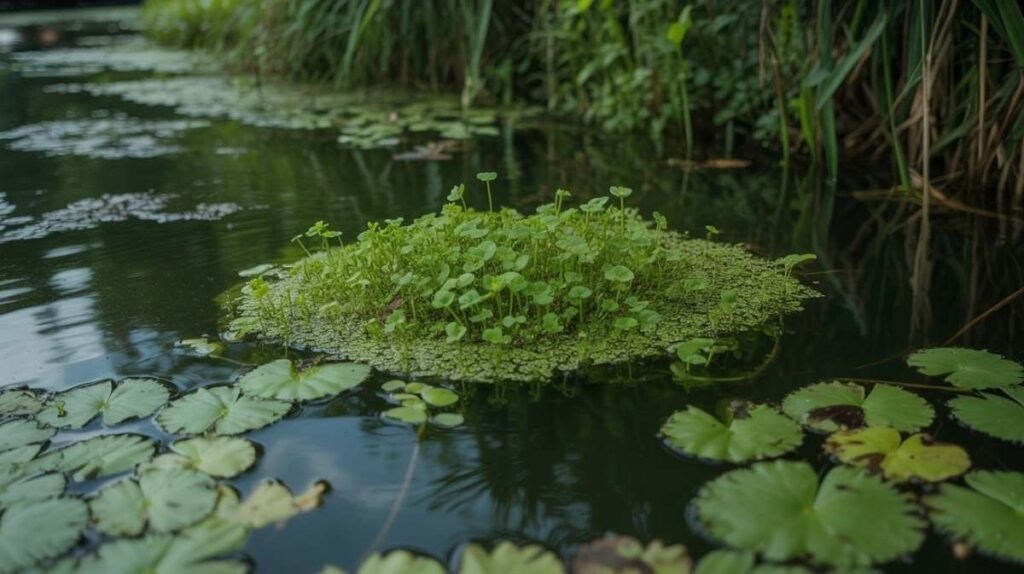
Floating plants are the single most underused category in betta care, and that is a mistake. Bettas in the wild spend significant time near the surface, resting under floating vegetation. It makes them feel secure from above. It creates the shaded, low-light conditions they genuinely prefer. And most floating plants are extraordinarily easy to maintain.
Amazon Frogbit (Limnobium laevigatum)
Amazon Frogbit is the best floating plant specifically for betta tanks. The leaves are round and substantial large enough that a betta can actually rest under them. The long, trailing roots hang down into the water column, creating a curtain that bettas explore and hide within.
One practical enrichment technique: hide food pellets among the Frogbit leaves. The betta hunts through the roots and leaves searching for them. It is a simple form of enrichment that encourages natural foraging behavior and keeps fish engaged with their environment.
Care is minimal. The main issues are too much water surface movement (which betta tanks should not have anyway) and snails eating the roots. Keep surface flow gentle, and Frogbit will spread across the top of the tank without any intervention.
Cover no more than 50–70% of the surface. Bettas breathe atmospheric air through their labyrinth organ and need unobstructed access to the surface.
Red Root Floaters (Phyllanthus fluitans)
Red Root Floaters are smaller than Frogbit, with leaves that turn deep red or pink under moderate light. They spread quickly and create a visually striking surface layer. The contrast between the red leaves and a betta’s coloration can be spectacular in a well-lit tank.
They are slightly more demanding than Frogbit — they need more light to develop the red coloration, and they melt in tanks with heavy splash from the filter. But in a calm, adequately lit betta setup, they are one of the most beautiful floating plants available.
Duckweed (Lemna minor)
Honest assessment: Duckweed is extremely effective at filtering water, blocking light, and covering the surface. It is also almost impossible to control once established. A few pieces will become full surface coverage within weeks. It will get into every other tank you own.
If you are comfortable managing it and want the most efficient floating plant for water quality, Duckweed is exceptional. If you want something easier to control, use Frogbit or Salvinia instead.
Stem Plants Fast Growers for Water Quality
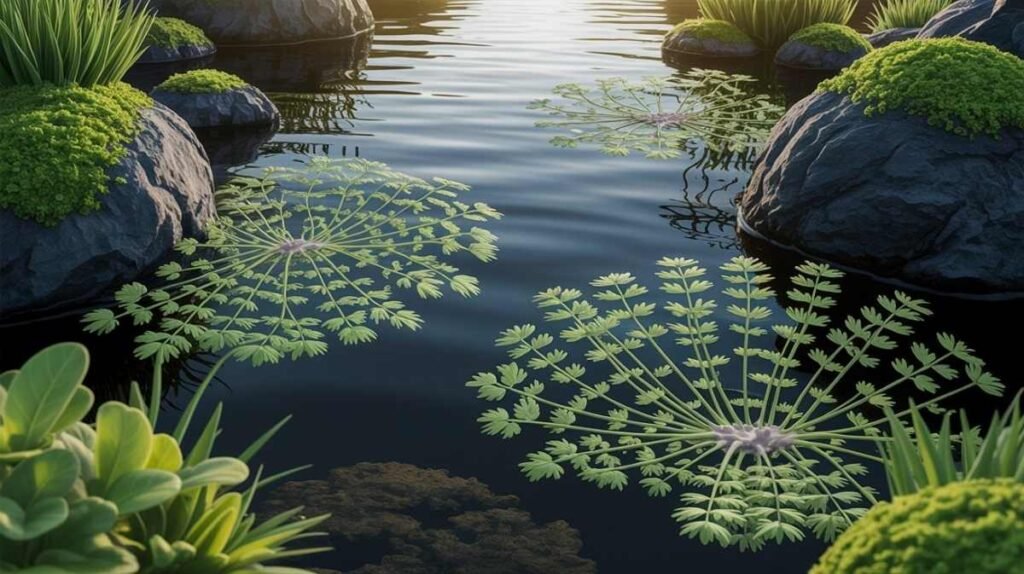
Water Sprite (Ceratopteris thalictroides)
Water Sprite is one of the most versatile plants in the freshwater hobby. It can be planted in substrate, where it develops into a lush mid-ground plant with lacy, finely divided leaves. Or it can be left floating, where it grows even faster and creates a dense mat of roots at the surface.
In a betta tank, floating Water Sprite is particularly useful. The root system it develops is dense and soft betta fry (in breeding setups) hide in it, and adult bettas use it as shelter. It absorbs nutrients aggressively, which means it helps keep water parameters stable between water changes. And it grows fast enough that you will be trimming or thinning it regularly, which is the point fast-growing plants consume waste quickly.
Hornwort (Ceratophyllum demersum)
Hornwort is a nitrate-absorbing machine. It grows fast, works in almost any water condition, and requires no substrate it floats freely or can be weighted down. In a tank with water quality challenges, Hornwort pulls nutrients out of the water at a rate that genuinely makes a measurable difference.
The downside for betta tanks specifically is texture. Hornwort’s needle-like leaves can be abrasive, and in a small tank with a heavily finned betta, there is real risk of fin damage. Use it in tanks 10 gallons or larger where the betta has space to navigate around it, or keep it weighted to the background where the fish is less likely to brush against it.
Plants to Avoid in Betta Tanks
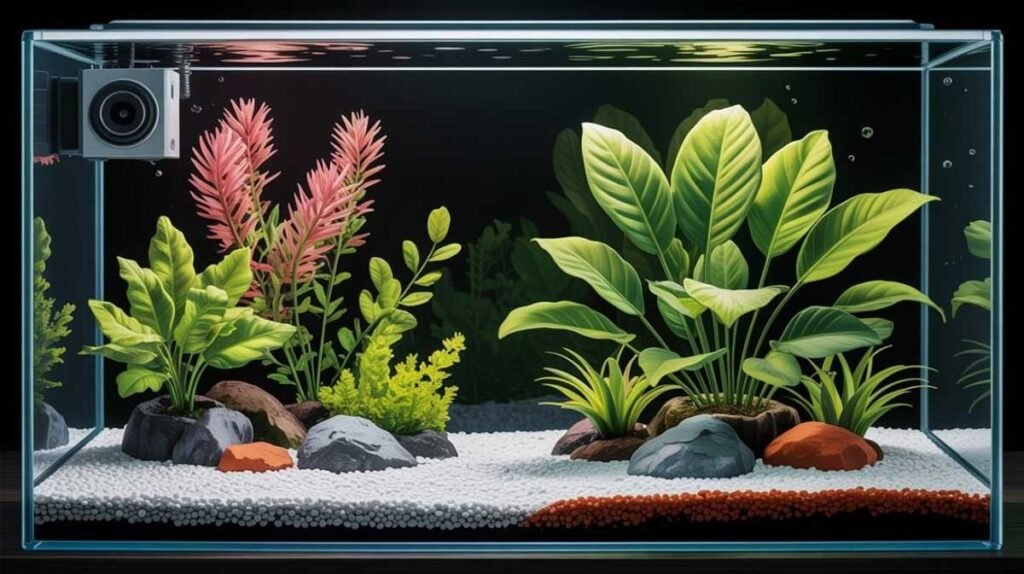
Some plants commonly sold as betta plants are not suitable at all.
Lucky Bamboo (submerged): Lucky Bamboo is not an aquatic plant. The stem can be partially submerged, but the leaves must stay above water. Fully submerged leaves rot within days, releasing ammonia into the tank and spiking parameters dangerously. It is sold as a betta plant constantly. Do not buy it for submersed use.
Peace Lily (submerged): Similar issue. Peace Lily roots can be submerged and do filter some waste, but the plant itself is not aquatic. The leaves and flowers must stay out of the water.
Toxic plants: Some plants sold for aquariums contain compounds harmful to fish. Plants in the Dieffenbachia family contain oxalates that are toxic to fish if they decompose in the water. When buying unfamiliar plants, verify they are specifically listed as aquarium-safe.
High-flow-dependent plants: Some stem plants need strong water movement to thrive. In a low-flow betta tank, they stagnate, trap debris, and die slowly. Rotala, for instance, can work in a betta tank but needs enough light and occasional flow to stay healthy — in a basic 5-gallon with a gentle sponge filter, it will struggle.
Setting Up a Planted Betta Tank From Scratch
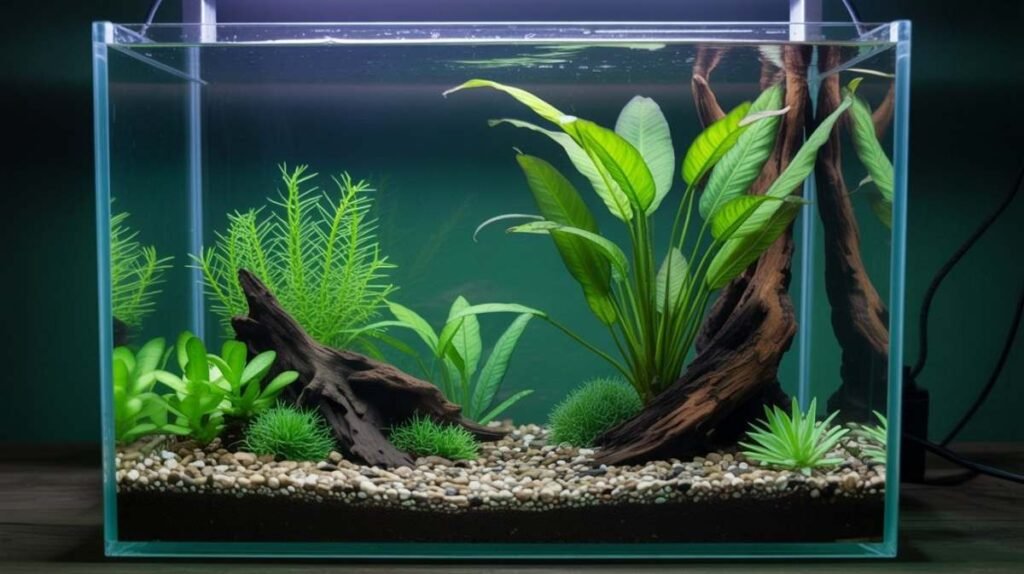
Substrate
For rhizome plants only (Java Fern, Anubias, Bucephalandra): plain aquarium gravel or sand works. These plants feed through the water column, not through roots.
For rooted plants (Cryptocoryne, Amazon Sword): either use a nutrient-rich planted substrate like Fluval Stratum or CaribSea Eco-Complete, or use inert substrate with root tabs placed near each plant every three to four months. Root tabs are compressed fertilizer capsules that feed rooted plants directly at the substrate level.
For a mixed setup (the most common approach): use inert substrate throughout and rely on root tabs for rooted plants plus a liquid fertilizer for the water column.
Light
Most betta-friendly plants are classified as low to moderate light. A standard LED aquarium light on an 8-hour daily timer is sufficient for Java Fern, Anubias, Cryptocoryne, and most floating plants. You do not need high-powered planted tank lighting for these species.
Keep the light on a timer. Consistent photoperiod matters more than intensity for low-tech plants. Irregular lighting schedules stress both the plants and the fish.
Fertilizer
For rhizome plants and floating plants: an all-in-one liquid fertilizer once a week is sufficient. Many planted betta tanks run these plants with no fertilizer at all and the plants survive — they just grow more slowly.
For rooted plants: root tabs every three to four months near the root system.
CO₂ injection is not required for any plant on the list above. It is optional and will accelerate growth, but no betta keeper with a low-tech setup needs it.
Starting Plant Quantities (By Tank Size)
| Tank Size | Recommended Plants | Surface Cover |
| 2.5 gallons | 1–2 small plants (Anubias nana, Java Fern, Marimo balls) | 30–40% floating |
| 5 gallons | 3–5 plants of varied types | 40–50% floating |
| 10 gallons | 5–8 plants including background options | 30–50% floating |
| 20 gallons | 8–12 plants, full layered aquascape possible | 20–40% floating |
Aquascaping Layout for a Betta Tank
The goal is to create layered depth foreground, midground, background, and surface — while leaving clear open swimming lanes.
Foreground: Low-growing plants or bare substrate. Dwarf Sagittaria or Java Moss work here.Leave the front third of the tank open for swimming.
Midground: Anubias on a piece of driftwood, small Cryptocoryne groupings. This is where the betta will spend most of its time and where enrichment plants do their best work.
Background: Taller plants like Vallisneria, Water Sprite planted in substrate, or larger Cryptocoryne varieties. These hide equipment and create visual depth.
Surface: 30–50% floating plant coverage. Amazon Frogbit or Red Root Floaters across the back half of the tank, leaving the front half open for surface access.
One piece of driftwood as a hardscape anchor is genuinely useful — it gives you a natural surface to attach rhizome plants without the plants looking randomly placed, and it leeches tannins that lower pH slightly, mimicking the soft, slightly acidic water bettas come from.
Common Problems and How to Fix Them
Leaves turning yellow: Usually a nutrient deficiency. Add a liquid fertilizer or root tab depending on the plant type. Also check that light duration is adequate.
Algae on leaves: Most common on slow-growing Anubias. Reduce light duration or intensity. A small crew of snails (nerite snails are excellent) will clean algae off leaves without harming plants.
Crypt melt: Normal. Leave the plant alone. Do not replant it, do not pull it out. New leaves emerge within two to four weeks.
Floating plants dying: Usually caused by water splashing onto the leaves from the filter outlet. Lower the outlet, add a spray bar, or redirect the flow away from the surface.
Java Fern rotting: Almost always caused by burying the rhizome. The rhizome must stay above the substrate. Detach the plant, reattach it to hardscape with the rhizome exposed.
FAQ
What is the easiest plant for a betta fish tank?
Anubias nana and Java Fern. Both attach to driftwood, need no special substrate, and thrive in low light with zero CO₂.
Do live plants actually improve betta health?
Yes. They absorb ammonia and nitrates, reduce stress, and give bettas surfaces to rest on all of which improve color, behavior, and immune function.
What plants are toxic to betta fish?
Lucky Bamboo and Peace Lily leaves will rot underwater and spike ammonia. Only use plants confirmed as fully aquatic and aquarium-safe.
How many plants does a 5-gallon betta tank need?
Three to five plants is ideal one Anubias on driftwood, one or two Cryptocoryne in the back, and a floating plant covering around 40–50% of the surface.
Can I use fake plants instead of live ones?
You can, but silk only plastic plants with sharp edges tear betta fins. Live plants are better because they actually improve water quality, which fake plants never will.

Jack Rivers is the founder of Plantsopedia, dedicated to making plant care simple, science-backed, and accessible for everyone. With a deep interest in botanical care and plant psychology, he specializes in rare tropical species and organic growth techniques, helping enthusiasts understand the soil, light, and biology behind every thriving plant. When he’s not experimenting with new propagation methods, Jack is busy turning complex horticultural science into practical, everyday advice for home gardeners