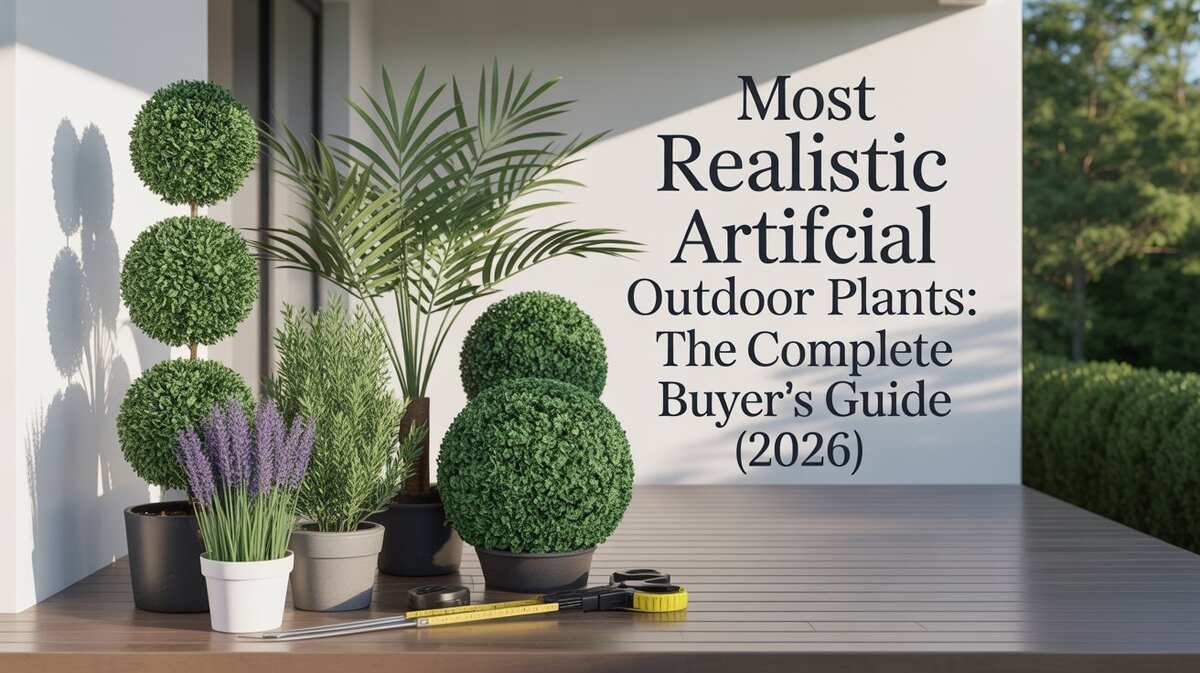
If you have ever pressed your hand against a faux fern on someone’s front porch and pulled it away wondering whether it was real, you already understand the power of today’s most realistic artificial outdoor plants. The industry has changed dramatically. Gone are the rigid sun-faded plastic stems that screamed fake from thirty feet away. What you find now are UV-resistant botanical replicas so convincingly lifelike that even curious neighbors have to reach out and touch them.
This guide answers your question directly: here are the 7 most realistic artificial outdoor plants available today, with a full breakdown of each one so you can choose exactly what your space needs.
The 7 Most Realistic Artificial Outdoor Plants
| # | Plant Name | Best For | Realistic Factor |
| 1 | Faux Boxwood Double Ball Topiary (50 to 54 inch) | Front door flanking, formal entryways | Tightly packed multi-tone leaves, natural stem proportion |
| 2 | Faux Italian Cypress Tree (9.5 ft) | Driveways, gates, architectural framing | Layered overlapping foliage, narrow columnar profile |
| 3 | Faux Bamboo Tree (9 ft) | Patios, pool decks, tropical styling | Individual cane sections with realistic node detailing |
| 4 | Faux Arborvitae Shrub (56 inch) | Borders, containers, foundational planting | Natural foliage layering, realistic brown base branchingIt looks exactly like what it is supposed to look like. |
| 5 | Faux Boxwood Hedge in Planter (72 x 65 inch) | Fence coverage, green walls, privacy screens | Uneven surface texture that catches light like a real hedge |
| 6 | Faux Pachysandra Garland (20 inch) | Railing draping, container trailing, wall mounting | Multi-directional foliage that reads natural from any angle |
| 7 | Faux Orchard Grass (31 inch) | Large containers, mixed arrangements, balconies | Fountain-like spread, soft natural movement in a breeze |
1. Faux Boxwood Double Ball Topiary: The Gold Standard of Outdoor Faux Plants
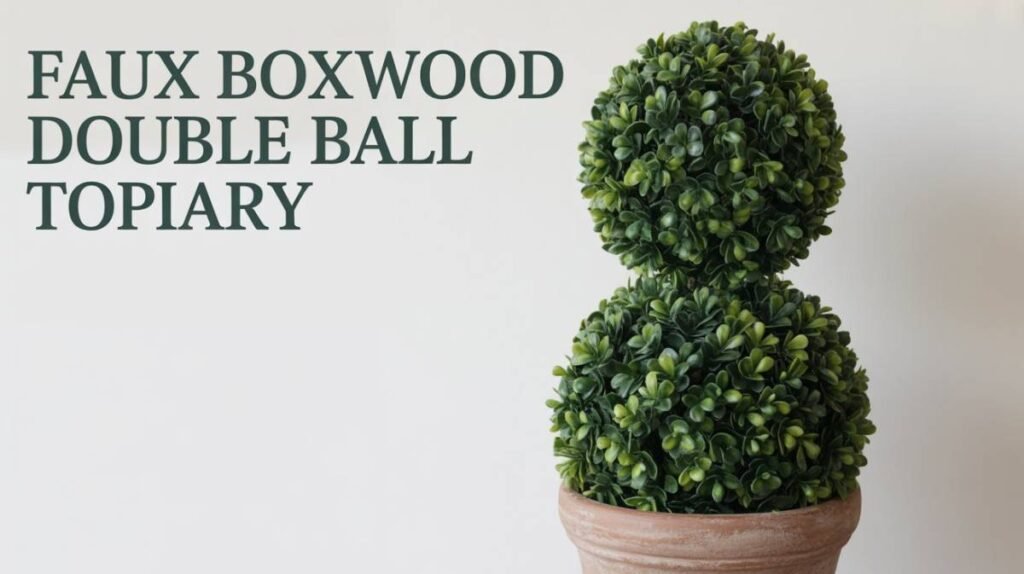
Honestly, if you only buy one outdoor faux plant, make it this one. The double ball topiary is the most convincing artificial outdoor plant on the market right now, and the reason is simple. Boxwood is naturally pruned into a geometric shape by real gardeners, so a well-made faux version does not look too perfect. It looks exactly the way it is meant to look..
The best versions pack three or more shades of green into each foliage cluster, with occasional brown or yellowed leaf edges that mimic real boxwood’s natural variation. At ten to fifteen feet away, most people genuinely cannot tell the difference. Go for the 50 to 54 inch size if your space allows it. The visual impact at that scale is completely different from the smaller versions. A weighted base, UV-stabilized materials, and dense foliage with no visible gaps are the three things worth checking before you buy.
2. Faux Italian Cypress Tree: Best for Height and Architectural Drama
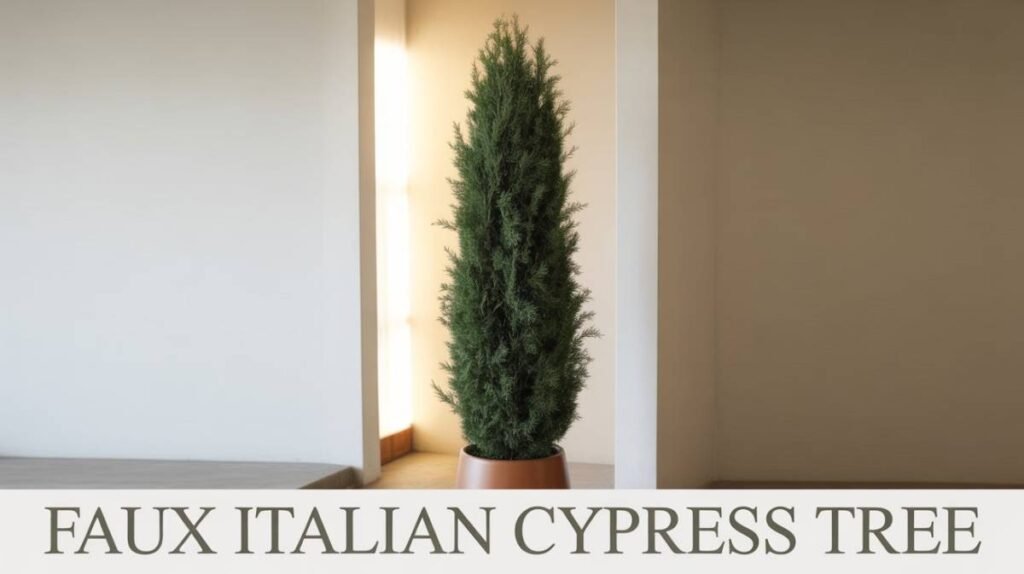
This is the plant that makes people stop and look twice. A 9.5 foot faux Italian cypress placed beside a gate or flanking a driveway creates the kind of formal Mediterranean presence that takes real cypress trees a decade to achieve in the ground.And it delivers that from the very first day.
The cypress works so well in faux form because the real plant is naturally tight, narrow, and relatively uniform. There is not much complex branching to fake. The best versions layer slightly varying green tones throughout the foliage rather than using one flat color, which is what gives them their depth and credibility. One thing to keep in mind: position it where people pass at a normal walking distance rather than directly beside a door where guests stand at arm’s reach. At distance it is genuinely convincing. Up very close, any faux plant invites more scrutiny.
3. Faux Bamboo Tree: Best for Patios, Pool Decks, and Tropical Vibes
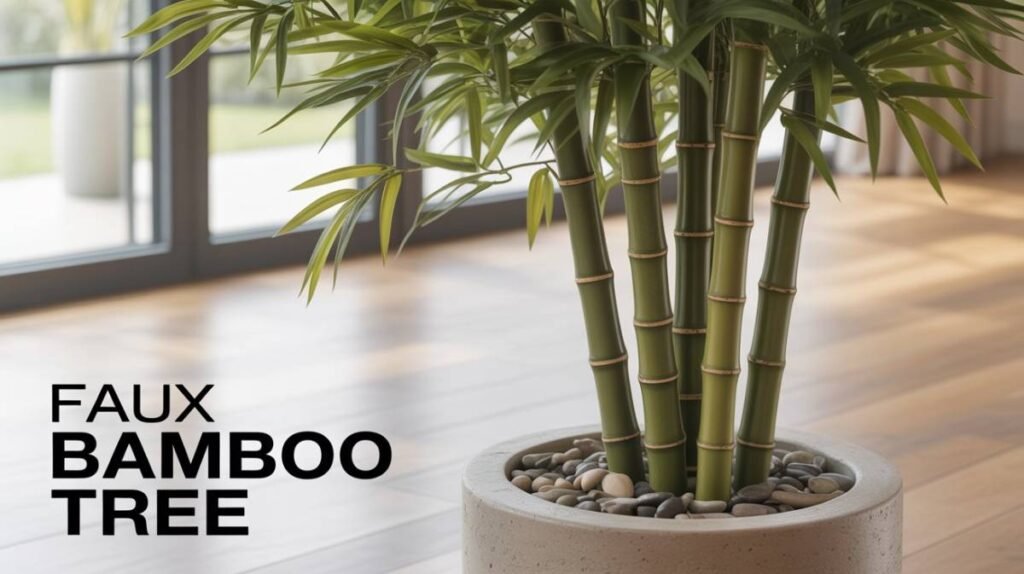
If you want your outdoor space to feel like a resort rather than a front porch, faux bamboo is your answer. A 9 foot version immediately changes the entire character of a patio, pool deck, or covered lounge area in a way that almost no other plant can match.
What separates a good faux bamboo from a bad one is the cane detail. Look for realistic node rings on each cane section and foliage that is fine and light enough to actually move in a breeze. That gentle motion is what makes bamboo look alive. It also works brilliantly in groups. Three plants of slightly different heights together in a large container creates an instant grove effect that looks genuinely lush. Bonus: no invasive roots, no spreading, no containment battles with real bamboo.
4. Faux Arborvitae Shrub: Best for a Natural Garden-Style Look
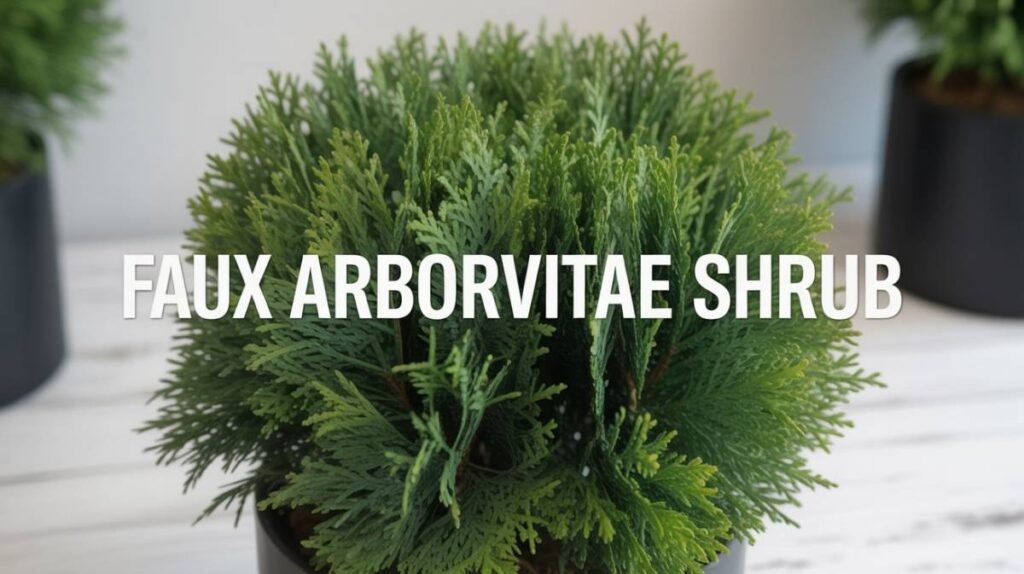
Not every space wants the formal symmetry of a topiary. If your home has farmhouse, cottage, or craftsman character, a faux arborvitae shrub at 42 to 56 inches gives you that naturalistic garden-grown look without any of the work involved in maintaining real arborvitae, which can be fussy about drainage and sun exposure.
The key quality marker here is how the foliage density changes from base to top. Good versions are slightly looser and more open near the ground, just like a real arborvitae, and get denser toward the center and crown. That variation is what makes it look grown rather than manufactured. You should also be able to see some brown branch structure at the base, which real arborvitae always shows and cheap faux versions always hide.
5. Faux Boxwood Hedge in Planter: Best for Walls, Fences, and Privacy
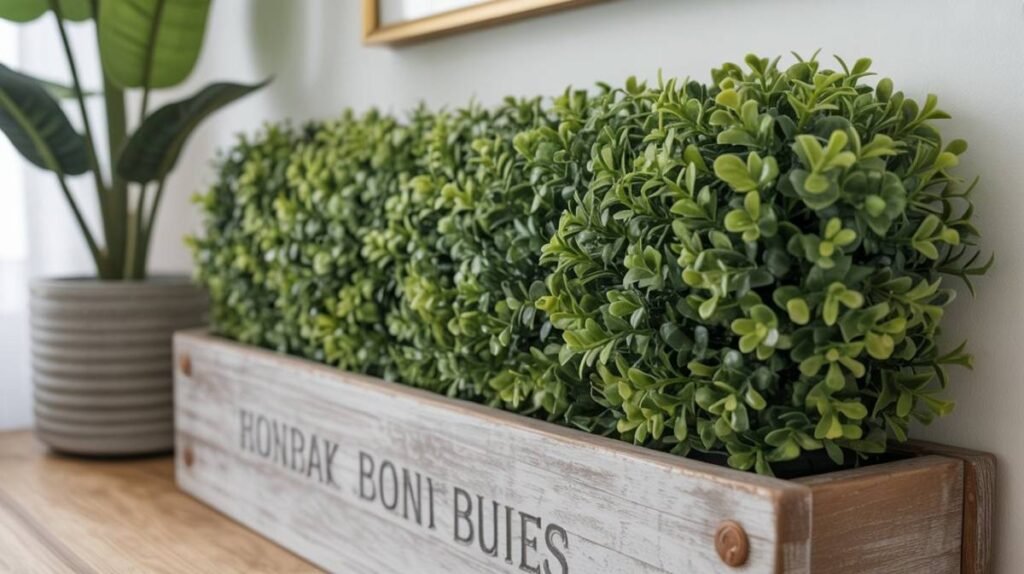
This one solves a completely different problem from the others. If you have a bare fence, an empty wall, or a patio boundary that needs immediate green coverage, a 72 by 65 inch faux boxwood hedge panel delivers what would take a real planted hedge years to grow. Instantly, with no irrigation, no trimming, and no seasonal dieback.
The detail that separates a convincing panel from a flat fake-looking one is surface texture. Real clipped hedges have a slightly uneven face where individual leaf clusters project at different depths, creating natural shadow variation. The best faux panels replicate this rather than presenting a perfectly flat surface, and the difference is immediately visible. These work especially well for commercial spaces, restaurant patios, and event venues where large-scale greenery needs to look polished without ongoing maintenance.
6. Faux Pachysandra Garland: Best for Trailing, Draping, and Filling Gaps
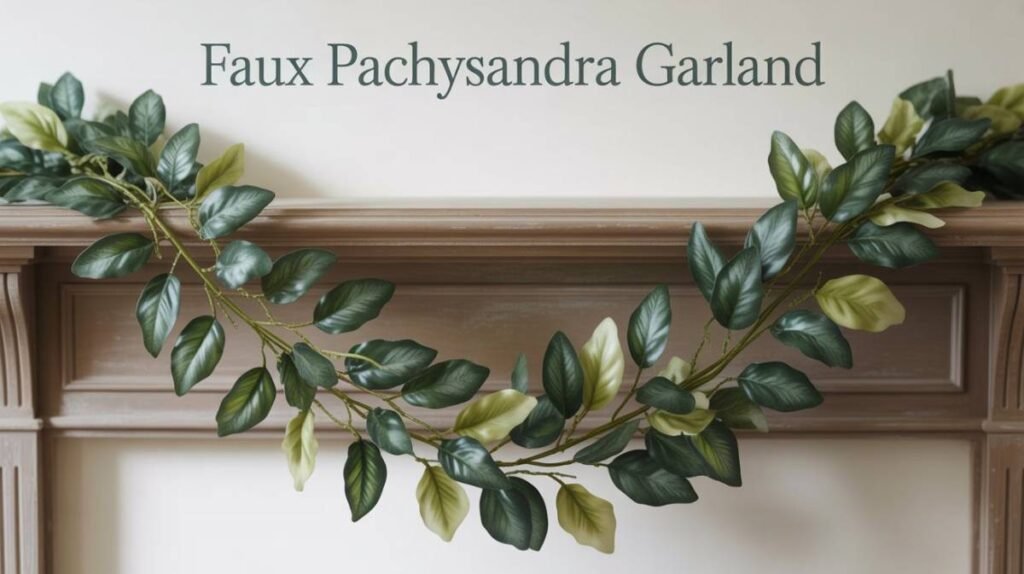
Pachysandra is the plant that fills the spaces between other plants in a real garden. The low, spreading, glossy ground cover that makes a mature garden look layered and abundant rather than sparse and arranged. The faux garland version brings exactly that quality to containers, railings, and wall-mounted planters where nothing else quite does the job.
Draped over the rim of a container it makes the arrangement look naturally overflowing. Wound along a porch railing it softens the whole architectural line. Trailing from a window box it adds the kind of casual abundance that makes an outdoor space feel genuinely lived in. Look for versions with multi-directional leaf structure, leaves that project at different angles rather than all lying flat, because garland gets viewed from above, below, and the sides simultaneously, and a flat product reads as fake from most of those angles.
7. Faux Orchard Grass: Best for Texture, Movement, and Mixed Arrangements
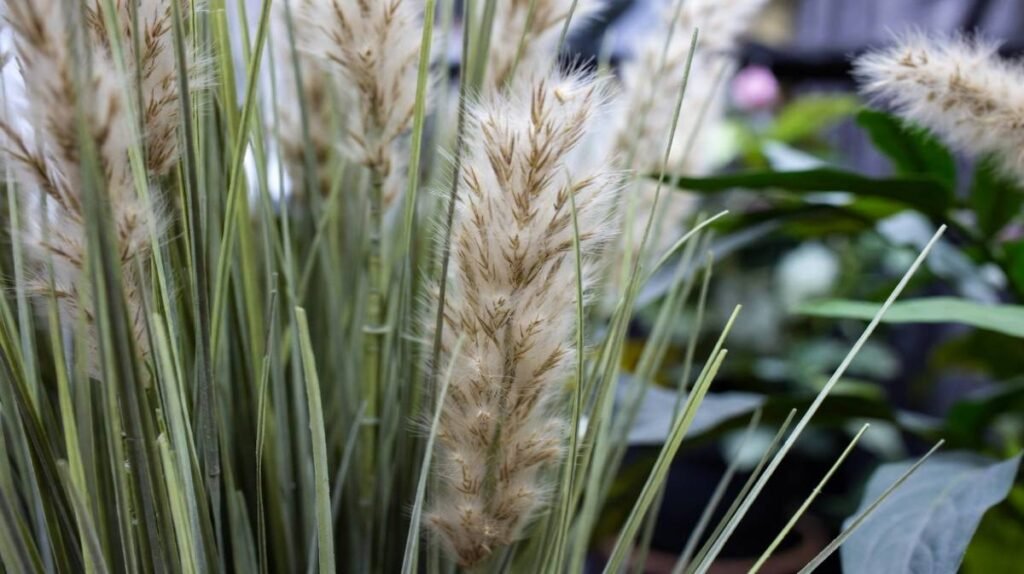
Grasses are notoriously hard to fake convincingly because real grass moves constantly and catches light along each individual blade in a way that rigid faux versions struggle to replicate. The 31 inch faux orchard grass gets closer than anything else in this category, mainly because the blade construction is fine and flexible enough to produce genuine movement in a light breeze.
The fountain-like form, blades arching outward and downward from a central crown, does a lot of the work on its own because the shape itself carries the impression of movement even when the air is still. It works best as part of a mixed arrangement rather than on its own, where its fine texture and loose form contrast beautifully against the tighter structure of boxwood, topiaries, or broad-leafed tropical plants. If your container arrangements feel stiff or one-dimensional, adding orchard grass almost always solves it.
Why Most People Are Switching to High-Quality Faux Outdoor Plants
The honest reason people choose realistic outdoor artificial plants is not laziness. It is practicality. Real plants in outdoor environments face a brutal combination of direct sun, irregular watering, temperature swings, pest pressure, and seasonal dormancy. Even dedicated gardeners lose plants every year. Faux plants eliminate those variables entirely.
| Reason | Why It Matters | Best Plant for This Need |
| Zero watering required | Looks the same on day one as it does in year three | Faux boxwood double ball topiary |
| UV-resistant construction | Resists fading for five to eight years in full sun | Faux boxwood hedge in planter |
| No seasonal replanting | Stays lush and full through every season without being touched | Faux arborvitae shrub |
| Works in any light condition | Thrives in shaded porches and north-facing entryways | Faux pachysandra garland |
| Allergy and pest free | No pollen, no aphids, no fungal disease | Faux orchard grass |
| HOA and rental friendly | Greenery without restriction in managed communities | Faux boxwood garland sections |
| Consistent curb appeal | Maintains its appearance 365 days a year | Faux Italian cypress tree |
| Long-term cost savings | Pays for itself within the first two seasons | Faux bamboo tree |
What Makes an Artificial Plant Look Genuinely Real?
Not all faux plants are created equal. The difference between a convincing botanical replica and a tacky plastic imitation comes down to four things.
Material Quality and UV Resistance
The single most important factor for outdoor use is UV-resistant polyethylene or polyester construction. Cheaper plants use basic polypropylene, which oxidizes and fades within a single season. Premium UV-protected artificial outdoor plants are built with pigments molecularly bonded to the material, resisting color degradation even after years of direct sun exposure. Look for products that specify UV-stabilized materials, not just suitable for outdoors in the listing description.
Botanical Detail and Variation
Real plants are irregular. Each leaf has slight color variation, veining, and imperfect edges. The most realistic artificial plants replicate this with multiple shades of green within a single stem, subtle yellow undertones on leaf edges, and layered foliage density that casts natural shadow. Mass-produced fakes use a single mold repeated identically, a dead giveaway the moment you notice it.
Weight and Structural Engineering
Lifelike outdoor artificial greenery moves naturally in a breeze. This requires stems with flexible wire armatures inside soft-touch PE coating, giving branches the kind of gentle sway that reads as organic. Rigid, perfectly still plants look fake. Plants that bob and flex in the wind look real.
Base and Container Integration
A beautiful artificial plant in an obviously cheap plastic pot loses most of its visual credibility immediately. Match your plant to a container with weight and texture, concrete, natural stone, aged terracotta, or heavy resin with a stone finish, and the whole composition gains instant credibility.
How to Style Outdoor Artificial Plants Like a Professional
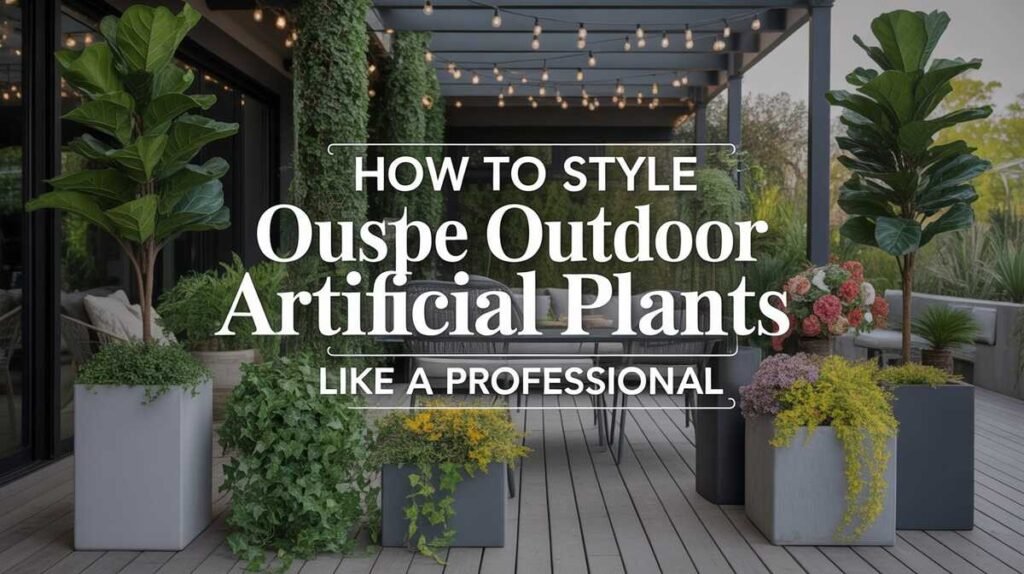
Professional exterior stylists work with a few consistent principles that produce polished results every time. None of them are complicated, but together they make a significant difference.
Layer by Height
Tall elements at the back or sides, medium plants in the center, trailing or low greenery at the front edge of the container. This dimensional structure is what separates a curated arrangement from a collection of plants that happen to be sitting next to each other.
Use Odd Numbers
Three or five plants read as a deliberate curated arrangement. Two or four read as an afterthought. This applies to individual containers and to groupings across a whole porch or patio.
Vary Texture Not Just Height
Mix fine-textured plants like orchard grass and pachysandra with tight-clustered forms like boxwood and with bold structural forms like cypress and bamboo. Textural contrast holds visual interest at every viewing distance, something that height variation alone never achieves.
Ground the Arrangement
Empty space at the base of a container reads as unfinished. Use trailing stems, faux ground cover, decorative gravel, or natural mulch to fill the visual gaps and make each arrangement look intentionally complete rather than planted and abandoned.
Think About Nighttime
Outdoor faux plants paired with well-placed uplighting look extraordinary after dark. Lighting a tall faux cypress or a double ball topiary from below creates dramatic shadow play that extends your arrangement’s visual impact well into the evening, which matters more than most people realize for overall curb appeal.
Maintenance Tips for Long-Lasting Outdoor Artificial Plants
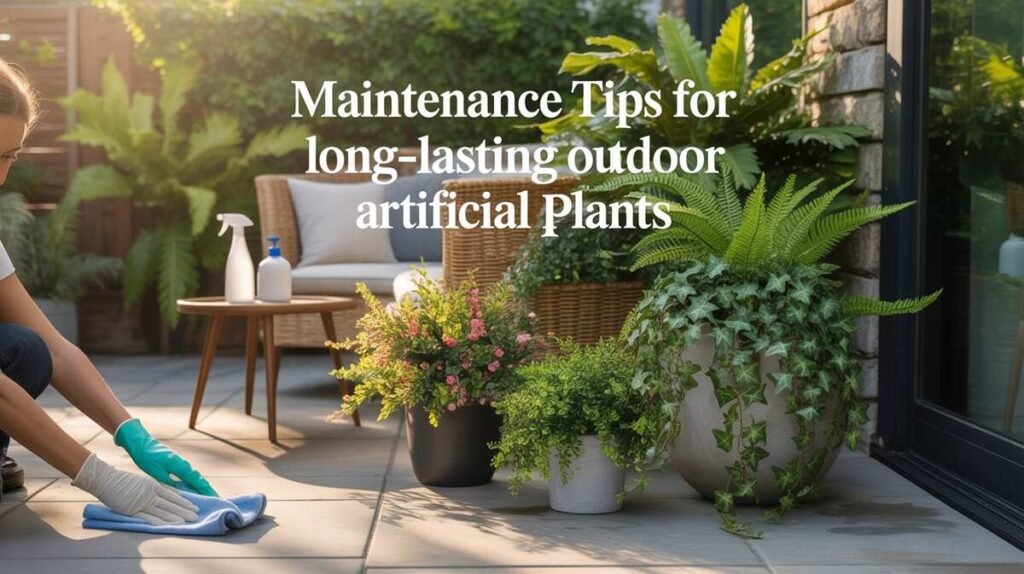
The main maintenance advantage of faux plants is obvious. No watering, no feeding, no pruning. But a few simple habits keep them looking their best for years rather than just seasons.
Clean Quarterly
A rinse with a garden hose removes most dust, pollen, and surface grime. For textured or dense foliage, a gentle spray with diluted mild soap followed by a clean water rinse restores the original appearance. Avoid high-pressure washing, which can dislodge leaves from stems on lower-quality products.
Anchor Tall Plants Properly
Tall faux plants, particularly trees and large topiaries, need to be properly anchored against wind. Weight the base container with sand or gravel, or use exterior-grade mounting brackets for fixed installations. A premium faux Italian cypress knocked over by wind loses its shape quickly and is genuinely difficult to fully restore.
Reshape After Shipping or Storage
Faux plants with flexible wire armatures can be reshaped branch by branch after flattening in transit or storage. It takes fifteen to thirty minutes for a large plant, but the difference in appearance between a carefully shaped and an unshaped faux plant is dramatic enough that it is always worth the time.
Store Fabric Florals Through Hard Winters
UV-resistant polyethylene foliage handles cold very well, but extended ice loading stresses connection points and can permanently bend flexible stems. In climates with regular heavy ice events, storing premium plants through the worst months adds years to their useful life.
Frequently Asked Questions
How long do UV-resistant outdoor faux plants last?
Quality UV-stabilized polyethylene plants hold their color and structure for five to eight years in direct sun, and even longer in shaded spots. Cheaper versions without true UV stabilization fade within a single season, so the material specification matters more than the price tag.
Can artificial outdoor plants withstand rain and humidity?
Yes. Quality outdoor faux plants are fully weatherproof. Rain, humidity, and temperature swings are not a problem. The only area worth checking periodically is the connection points between leaves and stems, as these show wear before the foliage does.
Do outdoor faux plants look fake up close?
At lower price points, yes. At the premium level, most people cannot tell the difference at conversational distance. Boxwood topiaries and cypress trees in particular hold up extremely well to close inspection. The key is positioning them where viewing distance is natural, not arm’s reach.
Are outdoor artificial plants safe for children and pets?
Food-grade polyethylene, used by reputable manufacturers, is non-toxic. Cheaper imported products are less predictable, so always check the material specification before buying, especially if kids or pets will be around them regularly.
Can I leave outdoor faux plants out in freezing temperatures?
Polyethylene foliage handles freezing temperatures without cracking or breaking. The real risk is heavy ice accumulation, which stresses connection points and can permanently bend flexible stems. In climates with serious winter ice, storing your premium plants through the worst months is worth it

Jack Rivers is the founder of Plantsopedia, dedicated to making plant care simple, science-backed, and accessible for everyone. With a deep interest in botanical care and plant psychology, he specializes in rare tropical species and organic growth techniques, helping enthusiasts understand the soil, light, and biology behind every thriving plant. When he’s not experimenting with new propagation methods, Jack is busy turning complex horticultural science into practical, everyday advice for home gardeners